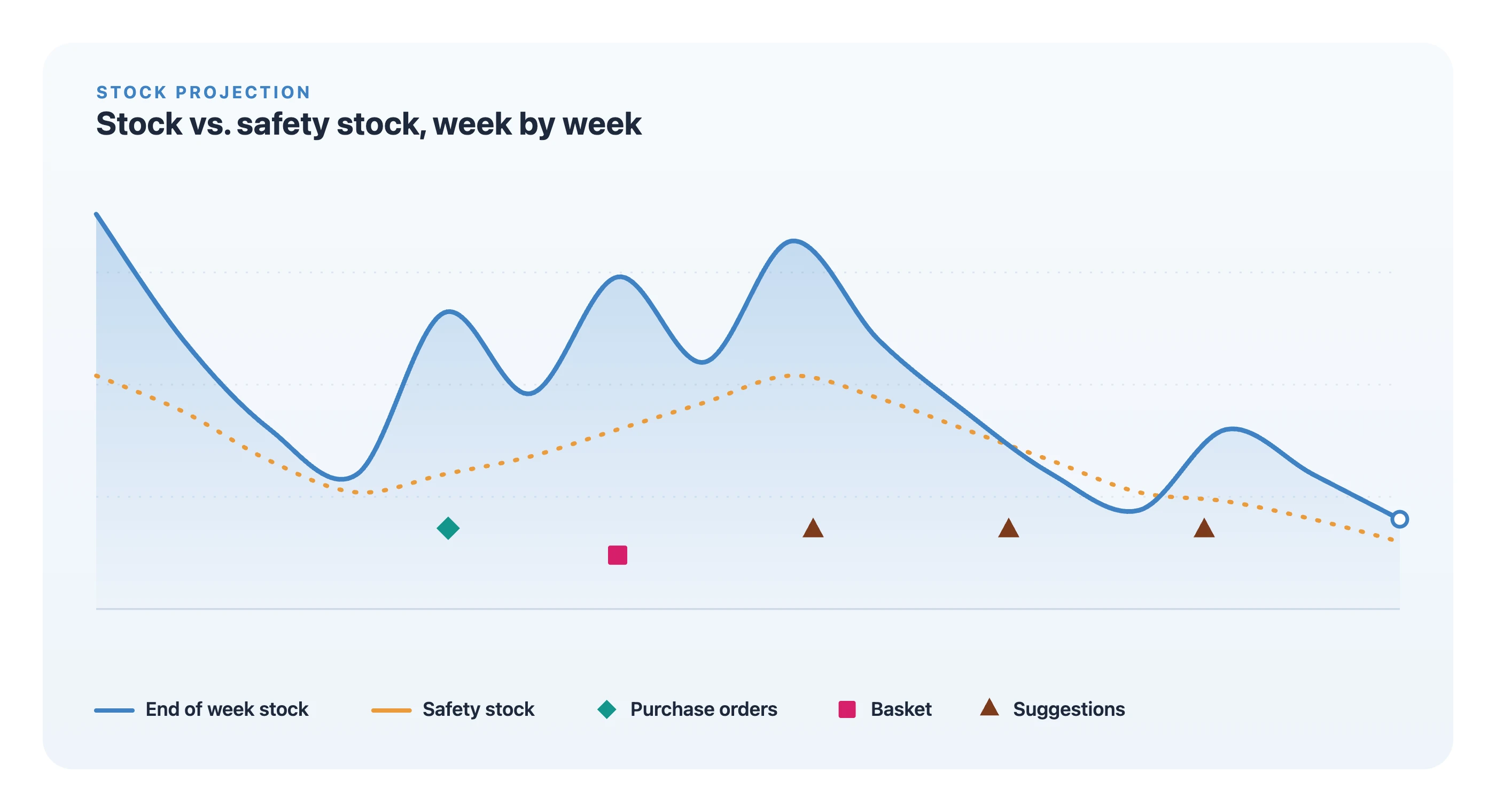
Fashion planning has a structural problem that few other industries share so severely. The most consequential decisions are made when the least is known, and by the time the market has told the brand what it actually wants, most of the money has already been committed.
A seasonal buy is placed months before the first customer sees the product. Fabric is reserved earlier still. By week three of the season, the brand knows a great deal about what is working, and can change almost none of it. This is the central tension of seasonal planning, and it explains why so much energy goes into pre-season forecasting and so comparatively little into what happens afterwards.
That balance is worth reconsidering. Pre-season accuracy matters, but it has a ceiling. In-season response has a much higher one, because it operates on real information rather than estimates. Fashion Planner is built around the idea that the season is something to be managed continuously, not something to be planned once and then reported on.
Seasonality is a shape, not a total
Most brands know their season totals well. They know that autumn is larger than spring, that a particular category peaks in November, that summer collapses in a specific week when the market goes on holiday. What is often missing is the shape inside those totals, expressed at a level that supports decisions.
The distinction matters because an accurate total combined with a wrong shape produces exactly the same operational problems as a wrong total. Stock that arrives evenly across a season with a sharp peak is short during the weeks that matter and abundant during the weeks that do not. The season closes at a respectable sell-through, and the customer experience during the peak was poor.
The shape also differs more than a single seasonal curve can capture. Categories peak at different moments. Outerwear does not follow the same profile as knitwear, which does not follow the same profile as accessories. Markets diverge, because a Nordic winter and a southern European winter are different commercial events happening under the same name. Channels diverge too, since online demand often builds and decays differently from wholesale sell-in.
A single company-level seasonal index is comfortable to work with and rarely accurate enough to plan against. Useful seasonality lives at the level where the decision is made, which usually means category and market at minimum.
Where the calendar interferes with the curve
Seasonal patterns are contaminated by calendar effects that have nothing to do with demand, and failing to separate them is a reliable source of forecasting error.
Easter moves between March and April, so a year-on-year comparison of those two months can show a dramatic shift that reflects only the calendar. The number of weekends in a month varies. Public holidays fall differently. Promotional periods like Black Friday have grown into multi-week events that shift volume between months rather than creating it. Weather arrives early or late and moves an entire category's peak by two or three weeks.
If these effects are not accounted for, the brand learns the wrong lesson from its own history. A category looks like it is declining when it has simply moved. A campaign looks like a failure when it was measured against an inflated comparison period.
Comparing like periods rather than like calendar labels solves much of this. Aligning to the same trading week, adjusting for the number of selling days, and separating promotional volume from baseline demand produces a curve that reflects customer behavior instead of calendar accident. It is unglamorous work, and it improves the quality of every downstream decision.
The first weeks contain most of the information
The most valuable planning signal in a season arrives early. Within a few weeks of launch, the relative performance of styles within a collection is usually clear, and it is far more stable than most teams expect.
Relative performance is the key phrase. Absolute forecasts early in a season are unreliable, because total volume depends on weather, marketing, and factors nobody controls. But the ranking within the collection tends to hold. The styles that look strong in week three are usually still strong in week twelve, and the styles that look weak rarely recover.
This is enormously useful, because most in-season decisions are relative rather than absolute. Which styles should get the reorder if there is capacity for three. Which styles should be pushed in the campaign. Which styles should be marked down early, while the discount required is still modest. Which styles should be moved between markets. All of these are ranking questions, and the ranking is available long before the totals are.
Acting on that early signal is where the value is. A brand that identifies its winners in week three and reorders where the supply chain allows has a materially better season than one that confirms the same conclusion in week ten. The information was identical. The difference was the willingness to act on it while it was still worth something.
Reading sell-through without fooling yourself
Sell-through is the standard in-season metric and it is easy to misread, usually in ways that flatter the reader.
A style that arrived four weeks late has a low sell-through because it has had less time to sell, not because it is failing. A style that was distributed to a fraction of the intended doors has a high sell-through because it is available in the best locations. A style that has been out of stock in its core sizes for two weeks has stopped selling for reasons that have nothing to do with demand.
Comparing sell-through across styles without adjusting for weeks on sale, distribution, and availability produces conclusions that feel data-driven and are not. It is a common way for a good product to be marked down early and a mediocre one to be reordered.
The more reliable view is rate-based: how much is selling per door per week while the product is actually available in a reasonable size range. That comparison holds up across styles that entered the season at different times and in different distribution, which is almost always the case in practice.
Availability quietly caps the season
One of the most common in-season mistakes is treating a stock-out as the end of a style's story rather than as an interruption in the middle of it.
When a style goes out of stock in the middle of a season, its sales stop. If the reporting looks only at sales, the style appears to fade. The natural conclusion is that demand ended. The actual conclusion is that supply did, and the brand has no way of knowing how much more it would have sold.
The effect compounds through the size range. A style that has lost its two central sizes has lost most of its addressable demand while still appearing to be in stock. Total inventory looks reasonable, the availability report is acceptable at style level, and the customer experience is poor.
This matters beyond the current season, because these depressed sales figures become the history that next year's forecast is built on. A style that was capped by availability teaches the planning system that demand was lower than it was, and the brand repeats the shortage. Tracking availability alongside sales is what breaks that loop, and it is one of the more valuable habits a planning team can build.
Markdowns are a timing decision
Every season produces products that will not sell through at full price. The question is never whether markdowns will happen. It is when they happen and how much they cost.
Early markdowns are cheaper. A style identified as weak in week four can often be moved with a modest discount, while the season still has enough time left for the product to be relevant to customers. The same style identified in week twelve requires a much deeper discount, competes with everyone else's clearance, and occupies warehouse space and working capital in the meantime.
The instinct to wait is understandable. Nobody wants to discount a product that might still recover, and there is always a reason to give it another two weeks. But the pattern across seasons is consistent: the cost of waiting is usually larger than the cost of being occasionally wrong about a style that would have recovered.
Making this decision earlier requires early and honest performance visibility, which is exactly what in-season management is for. A weekly view of rate-based performance, adjusted for availability and distribution, gives the team the confidence to act at week four rather than the ambiguity that makes waiting feel safer.
The season is a portfolio, not a set of styles
Seasonal decisions are often taken style by style, which misses the most powerful lever available in-season: moving product to where it will sell.
Within any season, the same style performs differently across markets, channels, and customers. A style that is disappointing in one market may be selling out in another. A color that is slow in wholesale may be performing well online. These differences are normal and they represent a real opportunity, because the stock already exists and has already been paid for.
Reallocation is usually faster and cheaper than any other in-season response. It does not require supplier lead time. It does not require new capital. It requires knowing where the imbalance is, early enough that the receiving market still has enough season left to sell the product.
That timing condition is the constraint. Moving stock in week five is a commercial action. Moving the same stock in week twelve is a logistics exercise that ends in a markdown at the destination instead of the origin. This is another case where the analysis is worth little unless it is fast, and where the frequency of review matters more than its sophistication.
In-season management is a rhythm
Everything described here depends on one thing: a routine that runs often enough to be useful. Seasonality analysis and sell-through reporting produce value only when they are converted into a repeating cycle with a short interval.
A workable weekly rhythm is not complicated. Review performance against the seasonal expectation. Identify styles running significantly ahead or behind. Check whether the underperformance is real or an availability artifact. Decide the actions available this week, which typically means reorder, reallocate, push, or mark down. Record what was decided, and look at it again next week.
The obstacle, as with most planning routines, is preparation time. If the weekly review requires two days of data assembly, it will not be weekly for long. It becomes monthly, then it becomes a season-end review, and at that point it is reporting rather than management.
Fashion Planner is designed to remove that preparation burden so the rhythm survives contact with a busy season. When the numbers are already current and the exceptions are already identified, the review becomes a short meeting about decisions rather than a project about data.
The season that teaches the next one
The final value of in-season management arrives after the season has ended. A brand that has tracked performance weekly, with context about availability, distribution, and timing, ends the season with something much more valuable than a sales total. It has an explanation.
That explanation is what improves the next pre-season forecast. Knowing that a category underperformed because it landed three weeks late is a different lesson from knowing that it underperformed. Knowing that a style was capped by size availability is a different lesson from recording it as a weak seller. Without this context, next year's plan is built on numbers that quietly encode last year's operational failures as demand facts.
This is how seasonality work compounds. Each season produces a cleaner history, which produces a better curve, which produces a better plan, which leaves more room to respond in-season. Brands that manage seasons actively tend to find that their pre-season accuracy improves as a side effect, simply because they understand their own history better.
The point of in-season management is not to rescue a season that was planned badly. It is to make sure the brand is still making decisions while decisions can still change the outcome, and to leave behind a record that makes the next season easier to plan.