Air freight is the most expensive way to fix a planning problem, and in fashion it is also one of the most common. A delayed production run, a bestseller selling faster than planned, a season opening earlier than the ship will arrive: switching a purchase order from sea to air is often the only lever left. Used well, it saves a season. Used by habit, it quietly eats the margin of the goods it carries.
This article is a practical framework for the air freight decision: what it really costs, which products justify it, and the most overlooked part, when you have to decide. Most expensive air freight is not caused by choosing the wrong mode. It is caused by deciding too late, when air has become the only option left.
What the switch really costs
Air freight is commonly priced at several times sea freight per kilo, and for garments that difference lands directly on the unit cost. On a basic cotton item with a low selling price, the extra freight can take a large share of the gross margin. On a high-value outerwear style it may be a few percentage points. The same decision can be either sensible or ruinous depending on what is in the box.
Freight is also only part of the picture. Switching mode often means splitting a shipment, handling extra paperwork and customs entries, and sometimes paying the factory to prioritise the order. Where the goods are bulky, as with knitwear, down jackets and footwear, volumetric weight rather than actual weight sets the price, and the case for air gets weaker still.
Against that stands the cost of not flying: the lost sales of arriving late, the markdown on goods that land after the selling window has moved on, and the lost trust with wholesale customers whose delivery windows were missed. The decision is always a comparison between these two costs, never a question of whether air is expensive in general.
Which products justify air freight
A useful rule of thumb is that air freight is worth considering when three things are true at once.
**The product carries enough margin to absorb the freight.** Calculate the extra freight per unit and compare it to the gross margin per unit. If it swallows most of the margin, flying only makes sense as a service decision for a key account, and it should be taken as one.
**Demand is concentrated in a window the ship would miss.** Fashion demand has a shape. Arriving three weeks late for a style whose peak is six weeks long loses half its season, while arriving three weeks late for a NOOS basic loses almost nothing because demand continues. Air freight pays off most on seasonal and trend-led items with a clear peak, and least on steady sellers.
**The demand is proven, not hoped for.** Flying in goods for a style that is already selling above plan, with visible projected lost sales, is a strong decision. Flying in goods to rescue a launch nobody has sold yet is a bet, and an expensive one.
A practical approach is to agree these criteria in advance, per category or price band, so the decision does not have to be argued from scratch every time a supplier emails about a delay.
The part everyone gets wrong: timing
Most discussions of air freight focus on whether to fly. The more important question is *when* the switch can still be made, because the option only exists for a limited window.
Think about a purchase order that is booked on a long sea journey. Two dates define its options.
- **Too early:** if departure is still months away, nothing needs deciding yet. The production date may move, sales may change, and a decision made now is based on information that will be outdated by the time the goods ship. - **Too late:** once departure is close, the goods are packed, booked and on their way to port. Changing mode at this point is disruptive, expensive or simply impossible. If the goods have already sailed, the decision was made by default.
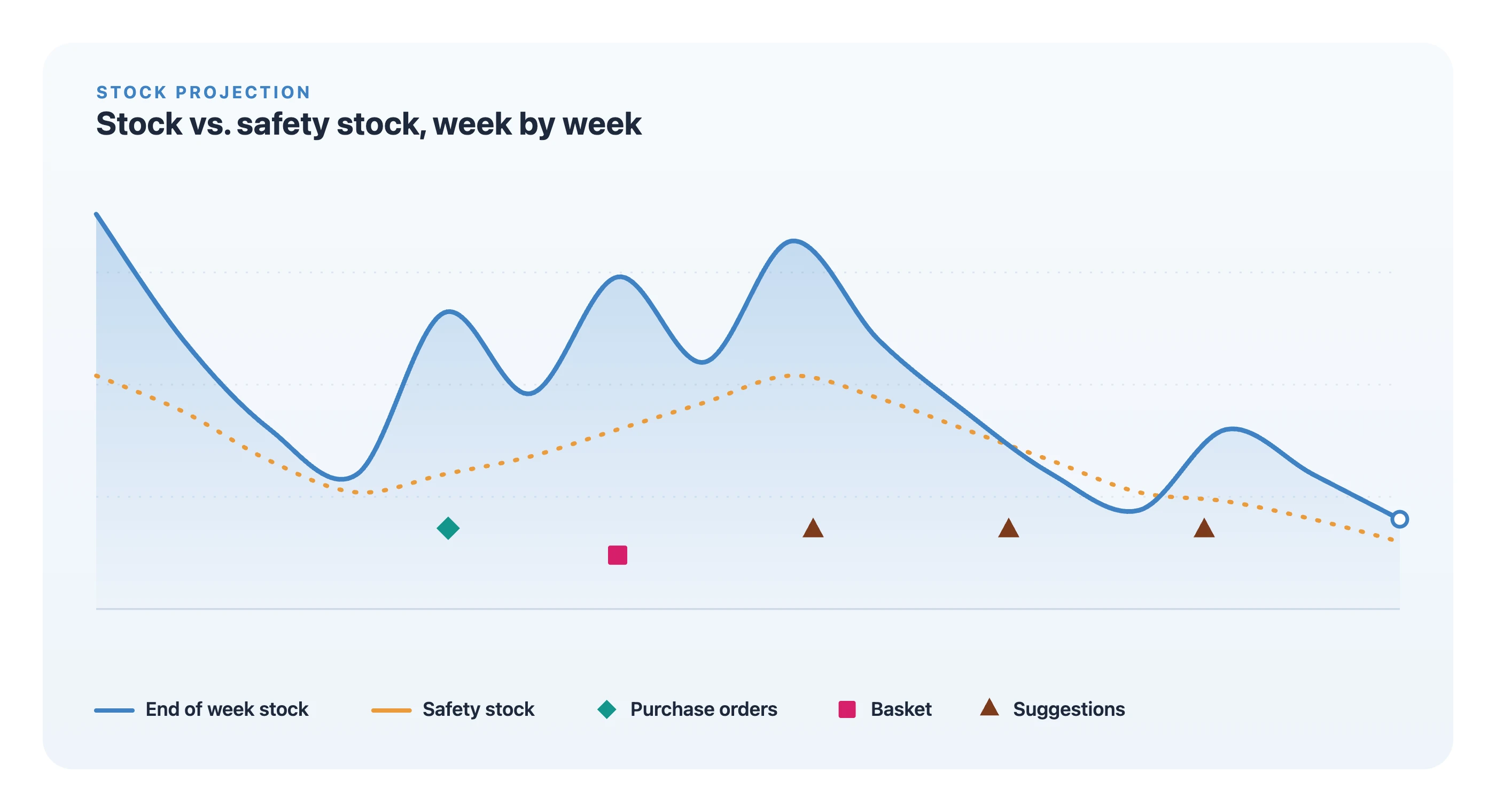
Between those two points is a decision window. It is short, typically a few weeks, and it is the only time the switch is both informed and cheap enough to make. A good air freight process identifies orders as they enter that window, checks them against demand and stock, and decides. A poor one finds out about the problem when the stock projection turns red, by which time the order has already left.
The journey length matters too. If the sea journey itself is short, flying saves only a few days and is rarely worth the money. The candidates are orders where the sea leg is long enough that switching to air saves weeks.
A simple air freight decision framework
Put together, the decision can run as a weekly routine rather than an emergency.
1. **List the orders in the decision window.** Take the open purchase orders with a long sea journey whose departure is close enough to decide on, but not yet too close to change. 2. **Check the stock projection for each.** Does the item go short before the sea shipment would arrive? How many units, in which sizes, and in which weeks of its selling curve? 3. **Put a value on the shortfall.** Projected lost sales multiplied by margin, plus any markdown risk from arriving late, is the cost of doing nothing. 4. **Compare it to the extra freight.** Extra freight per unit multiplied by the units you would fly. You rarely need to fly the whole order: splitting and flying only the sizes and quantity needed to cover the gap is often enough. 5. **Decide, and record why.** A decision that is written down, with its numbers, can be reviewed at the end of the season. Over time that builds a clear picture of which categories justify air and which do not.
The routine turns air freight from something that happens to the business into something it chooses, and in most cases it will reduce how often goods are flown, because problems are caught while the cheaper options still exist.
Reducing the need for air freight
The best air freight decision is the one you never have to make. The structural fixes are all about visibility earlier in the chain.
- **Plan against lead times, not order dates.** A stock projection that shows when each order lands, and where stock goes short in the meantime, reveals the problem months before it becomes urgent. - **Follow up on purchase orders.** Delays that are confirmed with the supplier and fed back into the plan early turn into sea freight re-planning, not air freight emergencies. - **Protect the right items with safety stock.** A buffer on proven sellers absorbs small delays that would otherwise trigger a switch. - **Split early.** When demand for a style is uncertain, shipping a smaller first part by sea and keeping the option to top up later is often cheaper than flying the whole thing late.
How Fashion Planner helps with the air freight decision
Fashion Planner builds the decision window into the planning tool. The item overview has a **Check air freight** filter that finds the item options with a purchase order still early enough to switch to air. That means an order with a long sea journey, more than four weeks between departure and arrival, and a departure date inside the four-week decision window but not yet within the final two weeks, when it is too late to change. Choose Yes to see only those options, or No to see everything else.
The same rule drives the air freight tile in "Your assistant", the brand dashboard. It counts the options worth moving to air this week, and a slider lets you look further ahead. From each option you go straight into its stock projection and lost sales, so you can put the shortfall next to the freight cost before you decide.
Fly by choice, not by default
Air freight is not good or bad. It is a tool with a clear price, and it pays off when the product carries the margin, the demand is real, and the ship would miss the window that matters. What makes it expensive is using it late and by habit, when the problem was visible weeks earlier and no one was looking at the right orders.
If you would like to see which of your open purchase orders are in the decision window right now, request a demo and we will show you with your own data.