Never Out Of Stock products look like the easy part of a fashion assortment. They are the styles the brand already knows. The basics, the carryovers, the continuity programs, the core colors that return season after season. They do not need a new design decision every six months, and they rarely surprise anyone at a sales meeting.
That is exactly why NOOS planning is so often underestimated. Seasonal collections get the attention because they carry the newness, the campaign, and the risk of a failed drop. NOOS quietly carries something else: a large share of turnover, a large share of the stock value on the balance sheet, and a service-level promise the brand makes to every customer who reorders.
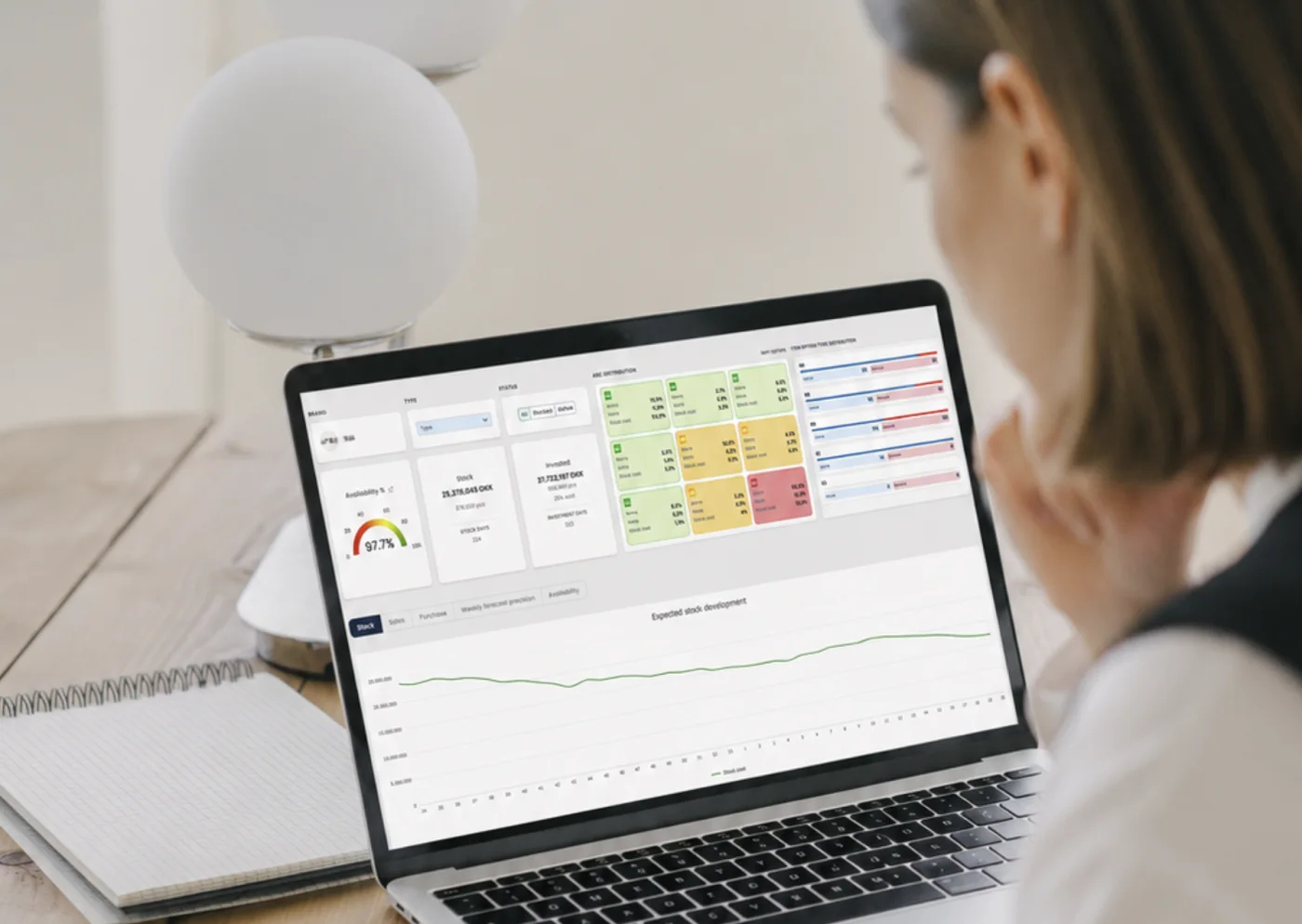
When NOOS planning goes wrong, it rarely goes wrong loudly. It goes wrong as a slow accumulation of small problems. A size that is missing for four weeks. A core color that arrives two months after the demand peak. A warehouse full of a basic that stopped selling a year ago but keeps getting reordered because nobody stopped the routine. Fashion Planner exists in part to make those small problems visible early, while they are still cheap to fix.
Why NOOS needs different logic than seasonal styles
A seasonal style is planned once. The brand estimates demand before the season, places the buy, and then manages what happens. The decision window is narrow and the consequences are largely fixed once the order is placed.
A NOOS product is planned continuously. It has no natural end date, so there is no single moment where the brand commits and moves on. Instead there is a repeating cycle of measuring demand, comparing it with stock and incoming supply, and deciding whether to order again. The quality of NOOS planning is not the quality of one decision. It is the quality of a routine repeated many times across many products and sizes.
This difference matters for the tools a brand uses. Seasonal planning rewards good judgment on a limited number of large decisions. NOOS planning rewards consistency across a large number of small ones. A planner can think carefully about forty seasonal styles. No planner can think carefully every week about eight hundred NOOS SKUs spread across sizes, colors, and warehouses without a system that narrows the list down to what actually needs attention.
Treating NOOS with seasonal logic is one of the most common planning mistakes. It produces the pattern many brands recognize: a big annual or biannual core buy that is right on the day it is placed and increasingly wrong for the eleven months that follow.
Availability is a promise, not a metric
For a wholesale customer or an online shopper, a NOOS product is a promise. It is supposed to be there. That is the entire point of the category. A retailer who reorders a core style expects it to be available, because availability is why they chose to build their assortment around it in the first place.
This means that a stock-out on a NOOS product costs more than the lost sale. It costs a small amount of trust. If a retailer is disappointed twice, they start carrying a competitor's basic alongside yours, and once the shelf space is shared it is difficult to win it back. The lost turnover is measurable. The lost position in the assortment usually is not.
Brands often measure this only at style level, which hides most of the damage. A style that is ninety percent available can still be missing exactly the sizes that matter. If the middle sizes are gone, the style is effectively unavailable to the majority of buyers even though the availability report looks acceptable. Real NOOS service level has to be measured where the customer meets the product, which means at SKU and size level.
Fashion Planner is built around that level of detail because that is where the commercial reality sits. Seeing current and future availability per size makes the difference between a report that says the style is fine and a report that says the style is about to disappoint a specific set of customers in three weeks.
Coverage is the number that drives the decision
The practical question in NOOS planning is not how much stock exists. It is how long the stock will last. Coverage, expressed as the number of weeks or months of demand the current and incoming stock supports, is the number that turns inventory into a decision.
Coverage compresses several things into one figure a planner can act on. It combines current stock, expected demand, and incoming supply. A product with high stock and high demand may need an order today. A product with low stock and almost no demand may need nothing at all. Absolute stock value cannot tell those two situations apart. Coverage can.
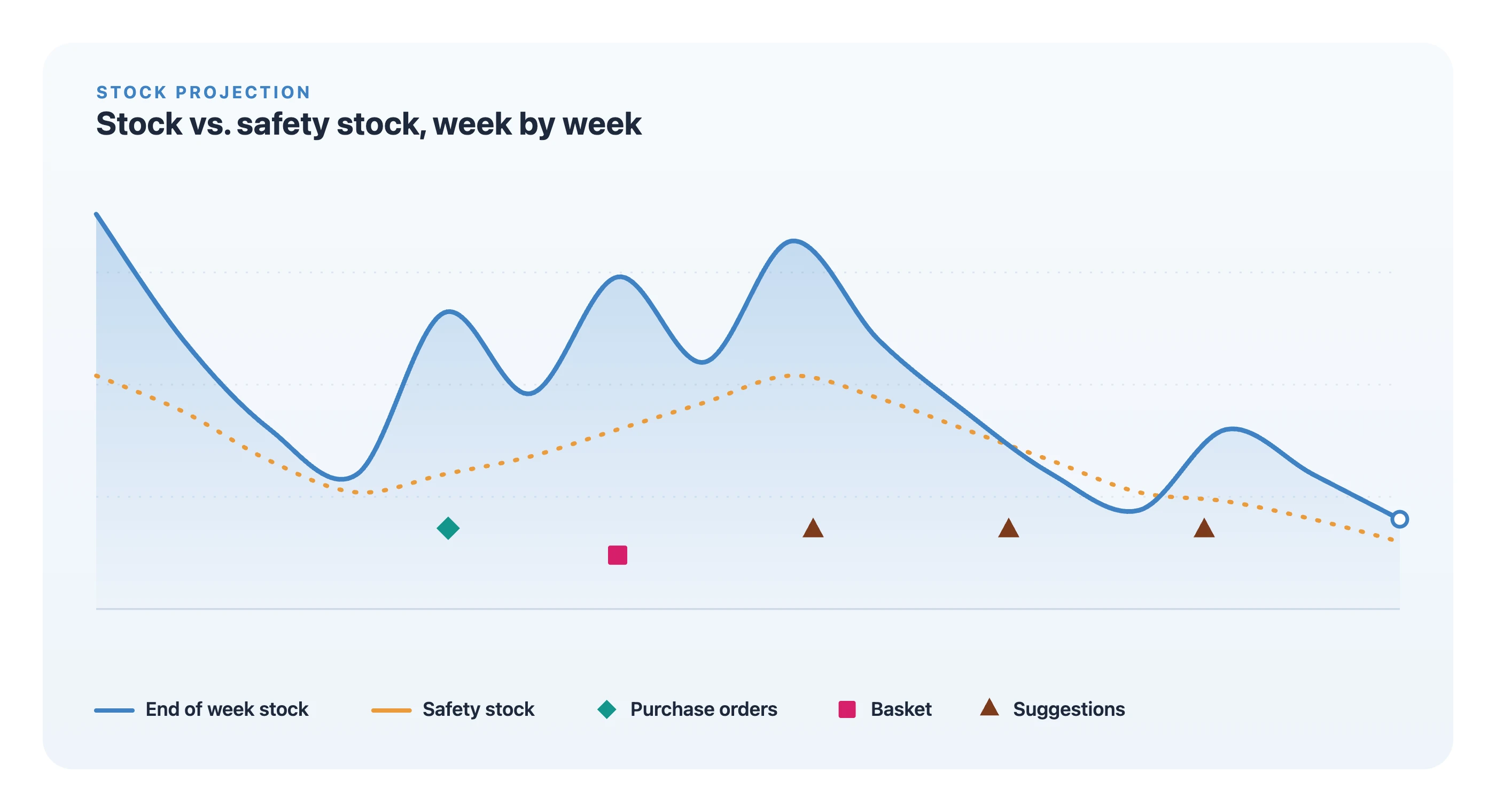
The comparison that matters is between coverage and lead time. If a product has six weeks of coverage and a sixteen-week lead time, the brand is already too late, regardless of how healthy the stock looks in the warehouse today. If a product has forty weeks of coverage and an eight-week lead time, the brand is carrying money it does not need to carry. Most NOOS problems are variations of these two situations, repeated across many products.
Making that comparison manually across a full core range is where the time disappears. Planners end up rebuilding the same spreadsheet every month, and because it takes so long, they run it less often than they should. Reviewing NOOS four times a year instead of every week does not reduce the number of decisions. It just means most of them are made late.
Lead time is part of the demand picture
Every NOOS decision is really a decision about the future, and the length of that future is set by the supply chain. A brand producing in Europe with a six-week lead time and a brand producing in Asia with a five-month lead time are not doing the same job, even if their products look identical on the shelf.
Longer lead times mean the forecast has to reach further ahead, which means it carries more uncertainty. They also mean mistakes are more expensive to correct. If a core product starts selling faster than expected and the replenishment horizon is five months, the brand cannot simply respond. It has to have anticipated.
This is why NOOS safety stock is not a matter of habit or comfort. It should be a deliberate response to two things: how variable the demand is, and how long it takes to react. A stable product with a short lead time needs very little buffer. A volatile product with a long lead time needs a real one. Applying the same rule of thumb to both is how brands end up simultaneously overstocked on some core products and short on others.
Fashion Planner helps by keeping lead time inside the planning view rather than in someone's memory or in a separate purchasing sheet. When the coverage figure and the reaction time sit next to each other, the priority becomes obvious without a separate analysis.
Not every core product deserves the same attention
Every NOOS range contains products that carry the business and products that are simply still there. The top core styles may represent a large share of turnover and deserve careful, frequent review. A long tail of low-volume core products may collectively tie up meaningful stock while individually deserving very little planning time.
Segmenting the NOOS range makes this manageable. High-value, high-volume core products can be reviewed frequently, with tighter service targets and a shorter planning cycle. Slow, low-value core products can be reviewed on a longer rhythm, with more tolerance for occasional stock-outs and a lower buffer.
Without this segmentation, planning effort spreads evenly across products that do not deserve equal effort. The result is familiar: hours spent on a marginal item because it appeared at the top of an alphabetical list, while a product carrying real turnover waits for someone to notice it.
The segmentation also supports a conversation many brands avoid. Some products stay in the NOOS range for historical reasons rather than commercial ones. Once the range is segmented and the tail is visible, discussing what should leave the core range becomes a normal part of planning rather than a difficult exception.
NOOS products do not stay flat
The word continuity suggests a straight line, and this is one of the most persistent misunderstandings in core planning. NOOS products are not seasonless. A basic T-shirt sells differently in June than in December. A core knit has a clear autumn profile. A staple in one market has a different curve in another.
Planning NOOS on a flat average produces predictable damage. Stock arrives evenly through the year while demand does not, so the brand is short during the peak and overstocked immediately after it. The average is correct across twelve months and wrong in most individual ones.
Demand also shifts over the longer term. Core products have life cycles, even if they are measured in years rather than seasons. A style that has carried a category for five years can decline slowly enough that no single month looks alarming, while the trend across two years is unmistakable. Reordering on last year's pattern keeps the decline invisible until the stock has already been rebuilt at the old level.
The reverse happens too. A core product can grow quietly, and a brand that reorders on historical averages will keep being short without ever understanding why. Both directions are only visible when the trend and the seasonal profile are looked at together, which is exactly the view Fashion Planner is designed to produce.
Sizes are where NOOS planning is won or lost
Style-level NOOS planning is comfortable and incomplete. The size curve is where the actual availability lives, and size curves are not static. They differ between markets, between channels, between customer types, and they drift over time as a brand's customer base changes.
Reordering a core product on the size split used at launch is a slow way to build a broken assortment. The middle sizes sell out repeatedly while the edge sizes accumulate. Over a few cycles, the remaining stock is dominated by sizes nobody is asking for, and the style shows healthy total inventory alongside poor real availability.
This is the situation many planners recognize as the hardest part of the job: knowing that a reorder is needed, and then having to manually break it into sizes across a large number of products. It is repetitive, it is error-prone in a spreadsheet, and it is the step most likely to be rushed when there is time pressure.
Fashion Planner supports planning at SKU and size level so the size split is derived from what has actually been selling rather than from the original assumption. That keeps the effort proportional to the decision and keeps the size mix aligned with real demand.
A weekly routine beats a perfect model
The most valuable thing a brand can do for NOOS is not to build a more sophisticated forecast. It is to shorten the review cycle. A modest forecast reviewed weekly will outperform an excellent forecast reviewed twice a year, because the weekly cycle catches errors while they are still small.
A workable NOOS routine is straightforward. Look at what has sold since the last review. Update the demand view. Recalculate coverage against lead time. Look only at the products that break a threshold. Decide, order, and move on. The value is in the frequency and the consistency, not in the elegance of the method.
Most brands know this. The obstacle is almost never the concept, it is the preparation time. When each review requires pulling data from the ERP, cleaning it, aligning it with open orders, and rebuilding the same calculations, the routine collapses under its own weight. It gets postponed, and then it gets postponed again.
Removing that preparation work is what makes the routine survivable. When the numbers are already there, the review becomes a short exception-driven meeting rather than a project, and it actually happens every week.
Exceptions, not full lists
A planner does not need to see every NOOS product every week. They need to see the ones where something changed. This distinction is the difference between a system that helps and a system that produces another report nobody reads.
The useful exceptions are specific. Products whose coverage has dropped below the lead time. Products where recent sales have moved significantly away from the forecast. Products with growing stock and falling demand. Sizes that have been unavailable long enough to affect the style. Products where an order is due now because of the supplier calendar rather than because of a threshold.
A list of thirty items that each deserve a decision is far more useful than a dashboard covering eight hundred that requires interpretation first. It also makes the work distributable, because a colleague can pick up an exception list and understand what is being asked of them without a long handover.
Fashion Planner is built around this idea. The point of the platform is not to show planners everything. It is to reduce the range to the decisions that matter this week, with enough context attached that the decision can be made immediately rather than researched first.
Order suggestions turn analysis into action
Analysis only creates value at the moment it becomes an order. The gap between knowing a product needs replenishment and having a purchase order ready to review is where a surprising amount of planning time disappears, and where errors are most likely to enter.
Order suggestions close that gap. Based on coverage, forecast, lead time, minimum order quantities, and the size curve, the system proposes what to order. The planner reviews, adjusts where their judgment says otherwise, and confirms. The mechanical work is handled, and the human attention goes to the cases that genuinely need it.
The intention is not to remove the planner. Commercial knowledge is exactly what a system does not have. A planner knows about the campaign that will lift demand next month, the customer who is about to expand, the supplier who is unreliable in July. Those factors belong in the decision. What does not belong in the planner's day is recalculating a size split by hand for the fortieth time.
This is also how NOOS planning becomes something more than one person's expertise. When the routine, the calculations, and the suggestions live in a shared system, the process survives holidays, handovers, and growth. That resilience is often worth as much as the inventory improvement itself.
Free cash and better availability at the same time
NOOS planning is frequently presented as a trade-off between service level and stock value. Better availability means more inventory, and less inventory means more stock-outs. In practice that trade-off is much weaker than it appears, because most brands are not sitting on a balanced core range.
The typical picture is imbalance rather than shortage. Some products are heavily overstocked, some are consistently short, and the total looks reasonable only because the two cancel out in the aggregate. Correcting the imbalance improves both numbers at once, and the initial gains usually come from stopping unnecessary reorders rather than from ordering more.
Getting there does not require a sophisticated model. It requires seeing coverage per SKU against lead time, reviewing frequently enough to catch changes early, planning at size level, and acting through concrete suggestions instead of periodic large decisions. None of this is conceptually difficult. It is simply hard to sustain manually across a full range.
That is the problem Fashion Planner is built to solve: making the core-range routine light enough that it actually runs every week, so the products the business depends on stay available without quietly absorbing more cash than they should.